
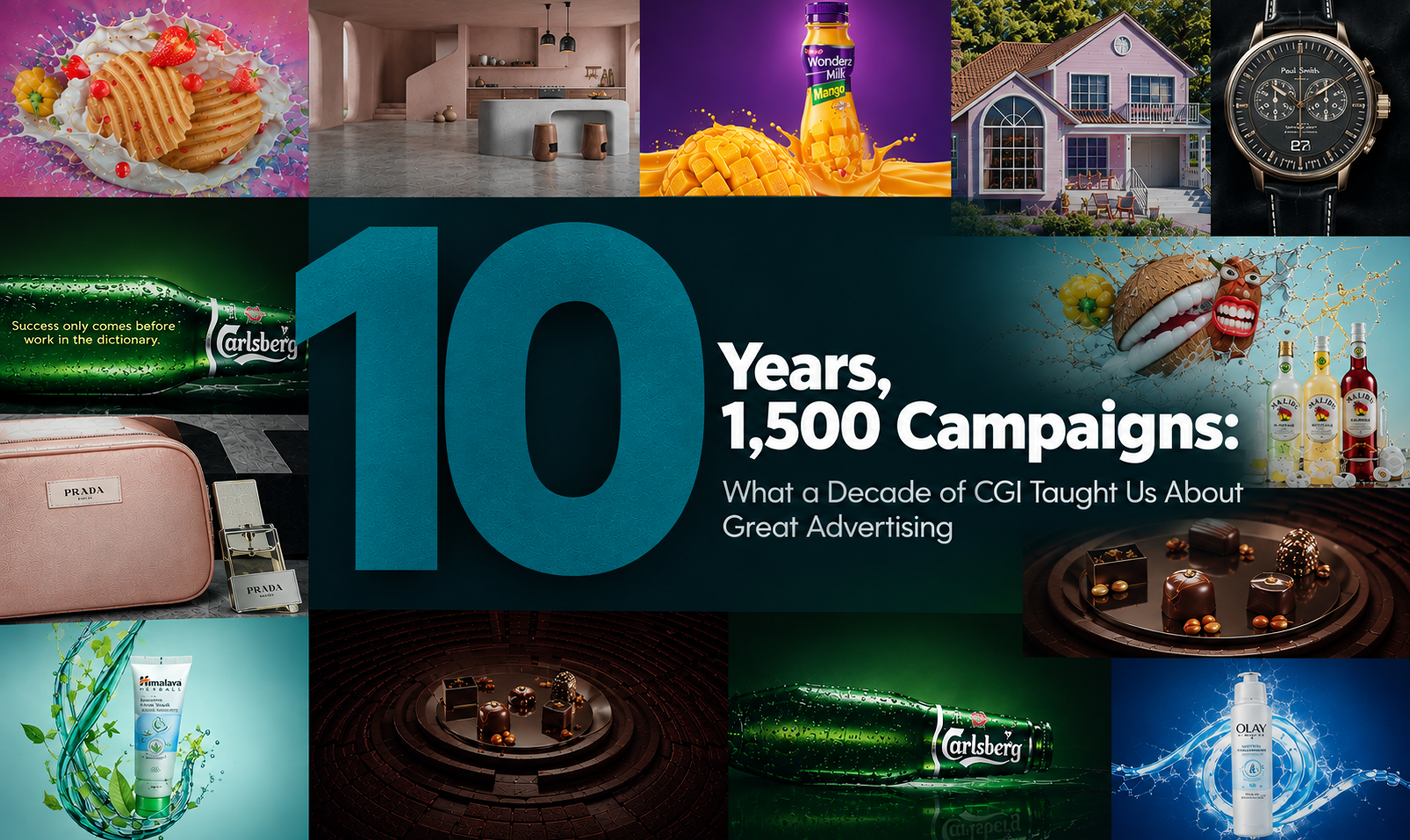
10 Years, 1,500 Campaigns: What a Decade of CGI Taught Us About Great Advertising
Ten years ago, a photoreal car that never existed, a product shot that defied gravity, or a world built entirely from light and math was a luxury reserved for the biggest budgets and the boldest briefs. Today, it's Tuesday.
Somewhere between then and now, Craving Digital made a lot of things that weren't real look completely, convincingly true. Since 2011, we've worked on more than 1,500 campaigns and projects for over 800 brands — directly and alongside agencies like Ogilvy, Dentsu, Leo Burnett and Havas. That's a decade of frames, deadlines, revisions and late-night renders. And it's taught us more about advertising than about advertising's tools.
Here's what stuck.
The technology changed. The job didn't.
When we started, CGI was often a rescue act — the thing you reached for when a shoot was impossible, unsafe, or too expensive to stage. A cinematic hero shot for Hyundai. A texture on a Fevicol frame that had to feel warm and human. A splash for Thums Up that no camera could catch at the right millisecond. The pitch was usually practical: we can do what the lens can't.
What changed is that CGI stopped being the backup plan and became the plan. Generative AI, real-time rendering and faster pipelines pulled the impossible into the everyday. Brands stopped asking “can you fix this in post?” and started asking “what could we imagine if nothing was off the table?”
But here's the lesson that a decade drilled into us: better tools don't make better ads. They just remove excuses. A photoreal render still lands flat if it isn't in service of an idea. The craft — lighting, timing, restraint, the instinct to know when a shot is finished — never got automated. It got more important, because everyone now has access to the same buttons. The difference is in the hands pressing them.
Brands got braver, and their expectations got sharper.
Early on, a lot of our conversations were about feasibility. Could it be done? By year five, the question had shifted to fidelity — could it be done perfectly, and fast? Now the conversation is about meaning. What is this frame supposed to make someone feel, and will they believe it?
That's a healthier place to be. Working with brands like Colgate, Parachute, Glow & Lovely, Mother Dairy and RIN taught us that the everyday products — the ones sitting in every home in the country — carry the highest bar for trust. Nobody forgives a toothpaste ad that feels fake, or a hair-oil frame that looks plastic. When a product is that familiar, the smallest wrong note breaks the spell. Photoreal isn't a flex there; it's the price of entry.
And then there's the other end of the spectrum — the brands that live on desire. A Vespa is an object of longing before it's a mode of transport. Tata carries the weight of an institution and the ambition of a challenger, sometimes in the same campaign. Those brands taught us that CGI's real gift isn't accuracy. It's aspiration. You're not rendering a scooter; you're rendering the feeling of the open road on a good morning.
The brands that got the most out of us over the years were the ones who understood that distinction. They didn't hand us a shot list. They handed us a feeling and trusted us to build the world around it.
What actually moves people (spoiler: not the render)
If you strip away ten years of tooling, the thing that consistently separated work that performed from work that merely looked expensive was storytelling. Not the effect. The reason for the effect.
We've seen gorgeous, technically flawless frames leave audiences cold, and we've seen simple ideas — executed with care — travel far beyond their budget. The renders age. The story doesn't. A great CGI campaign isn't the one with the most polygons; it's the one where you forget there's any CGI at all, because you're too busy feeling something.
That's also why trust turned out to be our most valuable asset — more than any pipeline. Trust with agency partners who put their client relationships in our hands. Trust with brands who let us take a swing on their most precious assets. You earn that the boring way: by hitting the deadline, by absorbing the round of changes without drama, by caring about the last five percent that most people can't even see but everyone can somehow feel. Fifteen hundred projects don't happen because of software. They happen because people call you back.
The next ten years
Generative AI is rewriting the economics of production right now, and we're leaning into it — not as a gimmick, but as another brush in a very old craft. It makes iteration cheaper, worlds bigger, timelines tighter. It also makes taste rarer and more valuable. When anyone can generate a thousand options, the ability to choose the right one becomes the whole game.
So the through-line from 2011 to today is almost stubbornly simple. Technology expands what's possible. Craft decides what's good. Storytelling decides what's remembered. And trust decides whether you're still in the room ten years later.
We've been lucky to spend a decade in that room — with Ogilvy, Dentsu, Leo Burnett and Havas, and with brands from Colgate and Hyundai to Vespa, Fevicol and Thums Up. Every one of those projects taught us the same thing in a slightly different accent: make people feel something true, and the technology will have done its job.
If you're planning something for the next ten years — a hero film, a product world, an experiment with generative content, or a frame you're not sure is even possible yet — we'd love to hear the feeling behind it. Talk to Craving Digital about your next campaign, and let's build something worth remembering.