

When Retouching Becomes Fine Art: Post-Production on Atul Kasbekar's “Honest”
There is a moment, deep in high-end retouching, when you stop looking at pixels and start listening to the photograph. You can feel what the image wants to be. You can also feel the exact point where a single adjustment too far would break the spell. Knowing the difference between those two states is the whole job. It is also, quietly, one of the hardest disciplines in visual craft.
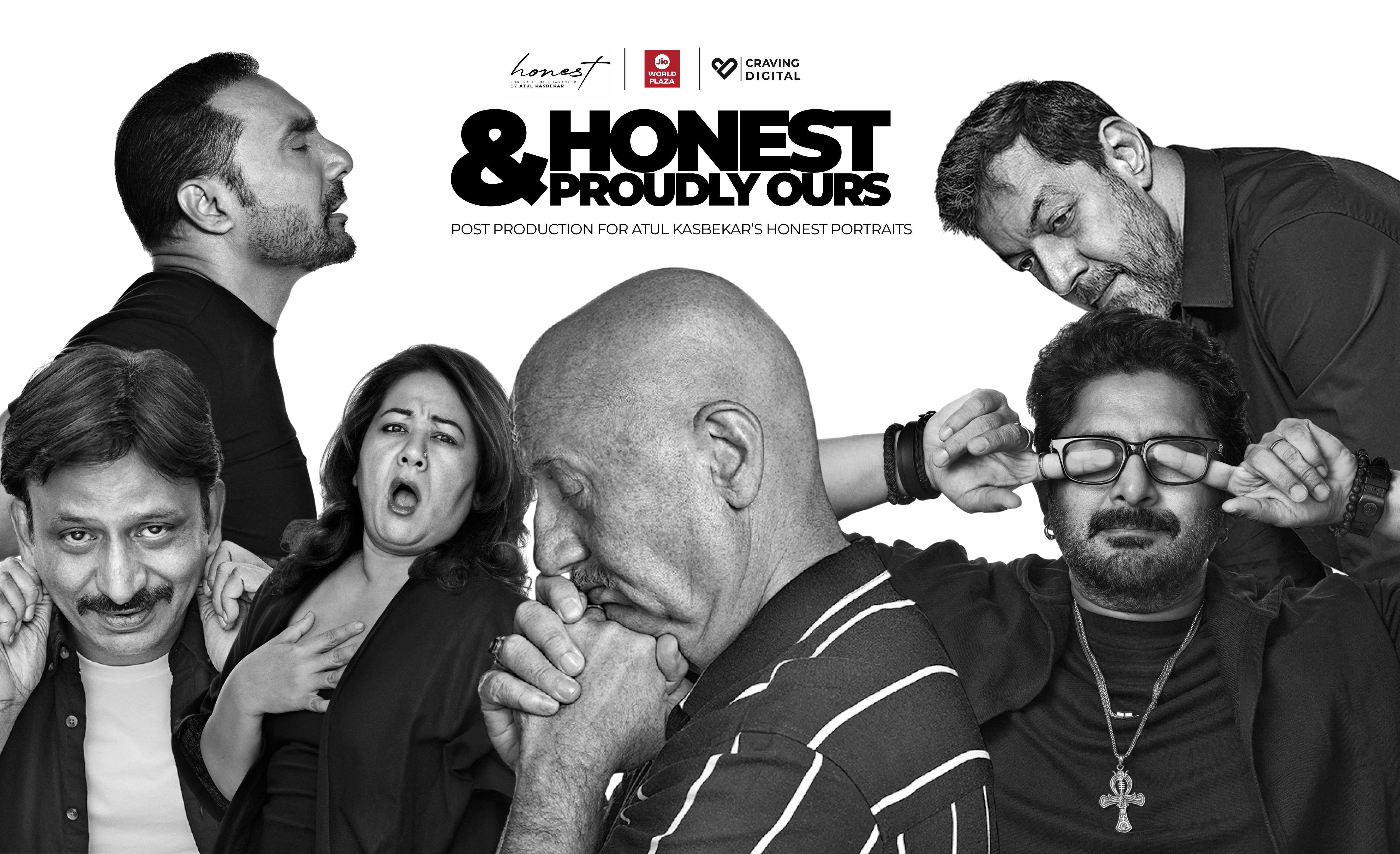
We were reminded of this while doing post-production and retouching for Atul Kasbekar's fine-art photography project “Honest.” Kasbekar is one of India's most recognisable photographers, a name that carries weight precisely because his images carry restraint. When work like that lands on your screen, you understand immediately that your role is not to impose. It is to serve.
The Invisible Discipline
Most people think of retouching as adding — smoothing, brightening, perfecting until something gleams. The best fine-art post-production is closer to the opposite. It is subtraction, patience, and enormous respect for what the photographer already captured in-camera.
The craft lives in the things you never notice. A distraction near the edge of the frame that quietly disappears. A tonal transition coaxed so it feels like light rather than a filter. A texture held exactly where it should be, so skin still reads as skin and fabric still reads as fabric.
When it is done well, the viewer feels only the photograph. They never sense the hours behind it.
That invisibility is the point, and it is also the difficulty. Commercial retouching often rewards the visible — the glossy, the flawless, the unmistakably enhanced. Fine art asks for the reverse. The mark of success is that no one can find your hand in the work. You are aiming for a result that looks as though it simply happened, as though the camera and the moment did all of it alone.
With a project titled “Honest,” that mandate becomes almost literal. The name itself is a brief. Whatever the frame holds, honesty is the assignment, and the retoucher's job is to protect it rather than polish it away.
Enhancing Without Altering the Soul
Here is the line every serious retoucher learns to walk. An image has a surface and it has a soul. The surface is fair game — dust, stray reflections, an uneven edge, a tonal dip that fights the composition. The soul is not. The soul is the reason the photographer pressed the shutter, and touching it is the one unforgivable move.
In fine-art work, that means every choice is made in service of an existing vision rather than a new one. You do not decide what the picture should say. You listen for what it is already saying and you clear the path so it can say it more clearly. Contrast that carries mood is preserved, not neutralised. Imperfections that belong to the truth of the image are left exactly where they are, because in this kind of photography a so-called flaw is often the very thing that makes it human.
This is the difference between commercial and fine-art post-production in a single idea. Commercial work frequently reaches toward an ideal — a brighter, cleaner, more aspirational version of reality built to sell something. Fine art reaches toward a truth. One asks you to improve upon what is there. The other asks you to defend it.
The technical toolkit can overlap. The intent could not be more different. And intent is what separates a retoucher who executes from one who can be trusted with a master's work.
The Trust in the Room
None of this happens without trust, and trust is the real material of a project like this. When a photographer of Kasbekar's stature hands over files, he is handing over more than data. He is handing over years of eye, instinct, and reputation, and asking you not to bruise any of it.
That trust changes how you work. You slow down. You resist the urge to demonstrate skill for its own sake. You ask what the photographer intended before you assume you know. You learn to leave things alone — which, for anyone trained to fix, is a discipline all its own. The most confident thing a retoucher can do is often nothing at all.
Approached this way, post-production becomes a genuine collaboration rather than a service handoff. The photographer's vision leads. The retoucher's craft follows closely enough to be invisible and skilfully enough to matter. When the two align, the finished image feels inevitable, as though it could never have looked any other way.
That is what a fine-art brief like “Honest” draws out of a studio. Not flash. Not spectacle. Just the quiet, exacting work of helping a great image be fully itself, and the restraint to know when to stop.
We think that is worth saying out loud, because retouching rarely gets the respect it deserves. It is treated as the last step, the cleanup, the technical afterthought. In truth, at this level, it is authorship of a very particular kind — the art of adding nothing the viewer can see and protecting everything that matters.
Let's Make Something Honest
Whether your next project is a fine-art series, a national campaign, or a single hero image that has to be perfect, the same principles hold. Great post-production begins with listening, runs on trust, and ends when the craft disappears into the image.
If that is the kind of work you care about, we would love to talk. Bring us your next campaign, your boldest idea, or the frame you cannot quite get right — and let's find out together what it wants to be.