

The Fizz Is Fake, the Craving Is Real: The Art of Beverage CGI
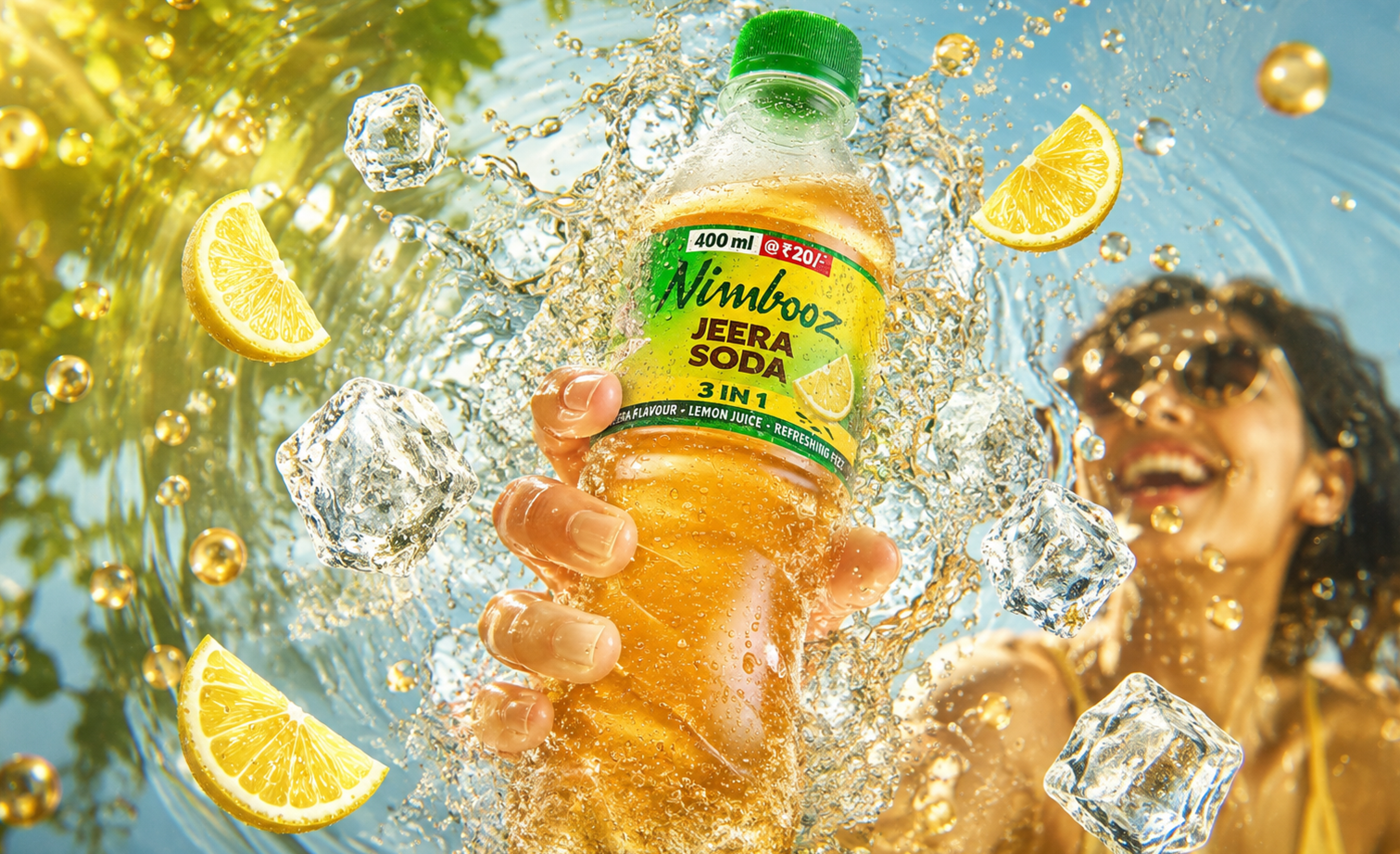
Look closely at the last drink ad that made you thirsty. The bead of condensation racing down the glass. The bubbles climbing in perfect, unhurried spirals. The splash frozen at the exact instant a wave of cola curls back on itself like a breaking surf. It looked spontaneous. It looked like someone got lucky with a fast shutter.
It wasn't luck. It was almost certainly built, droplet by droplet, in CGI.
That is the quiet secret of beverage advertising. The thing that makes your mouth water on cue is often the thing that never physically existed. And the craft of making it feel true, of making it feel wet and cold and alive, is one of the most demanding disciplines in the whole of visual production.
Why the Real Pour Never Cooperates
Anyone who has stood on a beverage shoot knows the heartbreak. You chill the bottle, you dress the frost, you cue the pour, and you get one take before the condensation slides off, the ice starts to cloud, and the surface goes flat. Carbonation has a mind of its own. Splashes never break the same way twice. The hero bubble you wanted rises in the wrong part of the frame, behind the label, out of the light.
Real liquid obeys physics, not the art director. And physics does not care about your storyboard.
CGI flips that relationship on its head. When a drink is built in 3D, every variable becomes a decision rather than a gamble. The size and rhythm of the carbonation. The precise arc of a pour. The way frost creeps across a can, thick at the base, feathering toward the top. Where the light passes through the liquid and where it catches an edge. None of it is left to chance, because none of it is happening in a room with a clock running.
That control is the whole point. A campaign for a drink as bold as Thums Up lives or dies on attitude, on that strong, unapologetic character in every frame. You cannot ask real cola to perform attitude on demand. You can absolutely engineer it in 3D, shaping the splash so it reads as powerful rather than messy, tuning the darkness of the liquid so it feels rich instead of muddy, backlighting it so the whole drink glows from within.
The Physics of Appetite
Making a beverage look irresistible is really a study in a handful of tiny, ferocious details, and each one is its own small art.
Take carbonation. Real fizz is chaos. In CGI, bubbles become a controllable system, and the artistry is in restraint. Too few and the drink looks flat and dead. Too many and it reads like soap. The sweet spot is a living, breathing effervescence where bubbles form, cluster, drift and pop with a believable variety of size and speed. Get that rhythm right and the audience's eye reads it, instantly and unconsciously, as fresh.
Condensation is where a drink earns its cold. That fine mist of droplets on a chilled surface is one of the strongest triggers of thirst we have, and in 3D it can be sculpted with absurd precision. Fat droplets gathering, merging under their own weight, and finally breaking loose to carve a clean trickle down the glass. On a lighter, zestier product like Nimbooz, that beading can be tuned to feel refreshing and clean, the visual promise of a cool lemony lift on a hot afternoon, rather than the heavy, sweating chill you might build for a cola.
Then there is the splash and the pour, the showpiece moments. This is where CGI does what a camera simply cannot. A pour can be sculpted into a shape that never occurs in nature: a ribbon of liquid that twists just so, a crown of droplets suspended at the perfect height, a wave that wraps a slice of lemon and holds. Every satellite droplet can be nudged, added, or removed. The moment can be stretched, slowed, and lit until it stops being a spill and becomes a piece of choreography.
Ice deserves its own mention, because bad ice ruins everything. Real ice is cloudy and melts on you. CGI ice can be made to look freshly cracked and impossibly clear, refracting the drink through its edges, throwing caustic sparkles of light across the scene, sitting in the liquid at exactly the angle that flatters both.
And underneath all of it sits light. Beverages are, optically, one of the hardest things to render because they are translucent, refractive and reflective all at once. Push light through from behind and a cola turns to molten amber; a citrus drink lights up like stained glass. That back-lit glow is what separates a drink that looks wet from a drink that looks delicious.
Where AI and the Human Hand Meet
None of this replaces taste, and that is worth saying plainly. Generative AI and smart tooling have become a genuine part of the beverage workflow, accelerating ideation, extending environments, and helping explore more looks in less time. Retouching remains the final polish, the pass where a frost pattern is perfected, a stray highlight is calmed, a label is made to sit flawlessly on a curved, sweating surface.
But the machine does not know what thirst feels like. A person does. The judgment about how bold a splash should be, how cold a can should read, how much fizz says premium rather than cheap, that judgment is human, earned over hundreds of brands and thousands of projects. The technology is the instrument. The craft is knowing which note to play.
That blend of engineering and appetite is exactly the work we love at Craving Digital. Building the impossible pour. Perfecting a droplet that would never hold still. Making a drink that exists only as data feel colder and more tempting than the real thing ever could on set.
The fizz might be fake. The craving is very real.
If you have a beverage, or any product that deserves to look irresistible, coming up on your calendar, let's talk. Tell us what you want people to feel, and we will build it, frame by frame, until it makes their mouth water. Reach out to Craving Digital and let's make your next campaign impossible to look away from.